More than repair: damage management for classic sports cars
Restoration of classic cars
What lasts a long time can still be damaged eventually—and often much faster than one would like: an accident on a country road, a garage fire, flooding after heavy rainfall, or even an attempted theft causing severe structural damage. For owners of historic vehicles, damage to their automotive treasures is far more than just a technical or material issue. It is reassuring to have the right partner at your side in such situations.
Damage to classic cars is a painful blow to any collector’s heart—after all, it is not merely a means of transportation, but a personal connection to a piece of automotive history, the preservation of sometimes considerable financial value, and ultimately also the safeguarding of cultural heritage. Consequently, a damaged historic vehicle is not an ordinary repair case, but a challenge that demands more. It requires professional damage management, carried out and supported by experienced specialists.
Accident, fire, and moisture damage:
Typical damage patterns in classic sports cars
Every damage to a historically significant motor vehicle is a case in itself, requiring an individual assessment and never to be judged in general terms. Damage to classic sports cars does not follow a uniform pattern – and yet there are typical scenarios and types of damage that we repeatedly encounter over the years in our restoration workshop. Most of these cases share one thing in common: damage very rarely affects only a single component, but often deeply impacts the historical integrity of the vehicle.
Why is that?
In automotive engineering, crash testing as we know it today was only introduced by Mercedes-Benz in the late 1950s. Only after that did manufacturers begin to incorporate repair-oriented design principles into vehicle construction and implement them accordingly.
As a result, accident damage often leads to significant structural deformation, largely independent of the individual crash scenario, impact speed, or specific points of collision. Damaged sheet metal and aluminum bodies, as well as destroyed attached components, often present repair shops without relevant experience with seemingly unsolvable challenges. After all, we are usually dealing with handcrafted original components, which means there are no standard, simple, or quick “one-size-fits-all” solutions. Accident damage must always be understood, assessed, realigned, or reconstructed within the context of the original design in order to prevent any further avoidable loss of original material. This is recognized by the experienced bodybuilders of the Hapke team and is communicated accordingly in damage management and in the handling of insurance claims in a robust and substantiated manner.
Moisture damage—and even flood damage—may initially appear less spectacular and complex than accident damage, but it is no less critical. Onset corrosion, as well as damage to the electrical system and interior, often unfolds its true impact gradually, in some cases over years. This is where experience is required in order to correctly assess how deep the damage actually extends—and which measures are necessary to prevent progressive secondary damage. Our credo: as much as necessary, as little as possible.
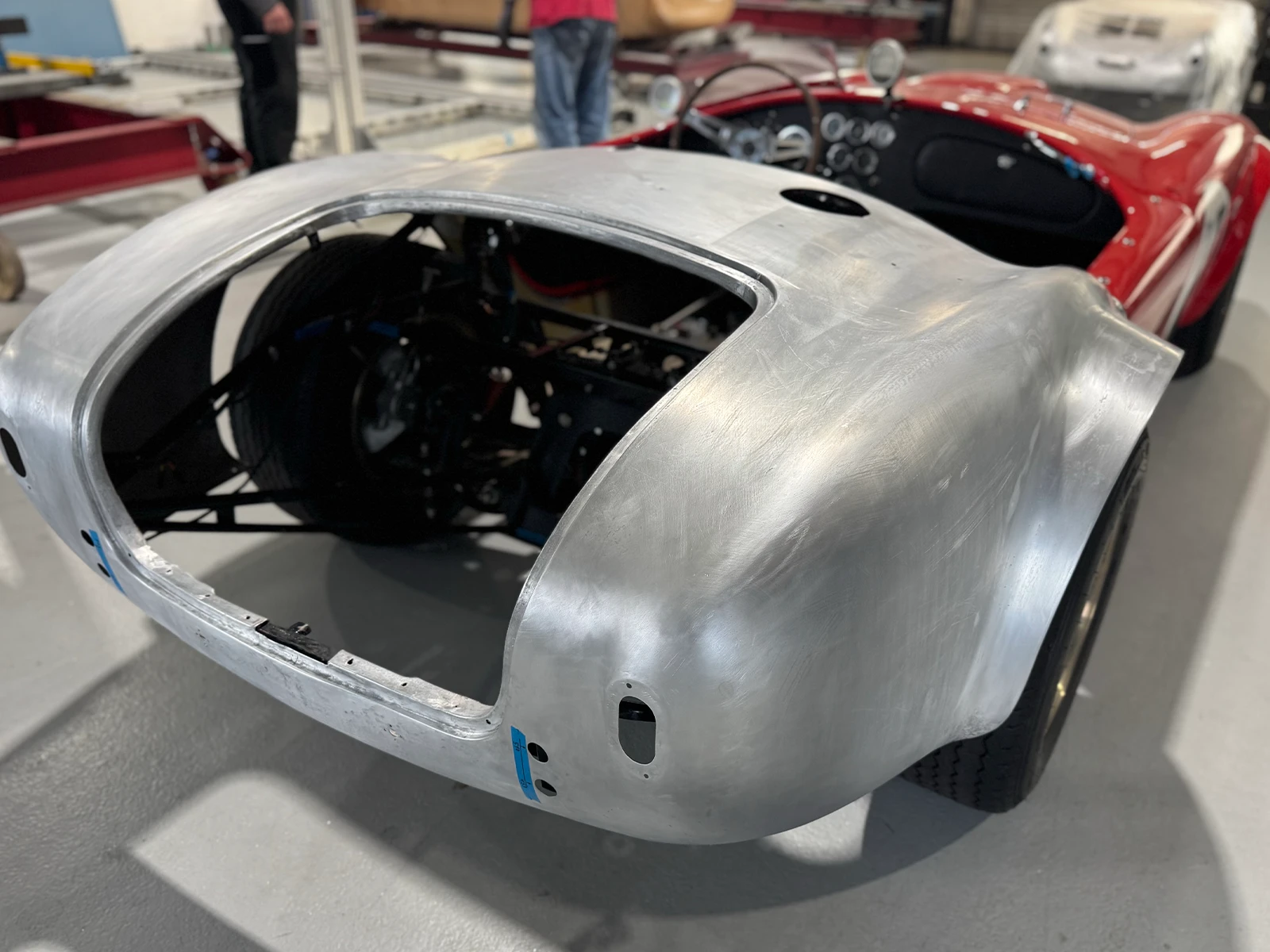
Shelby Cobra, accident repair: rear-end damage
Damage resulting from (attempted) theft also frequently follows recognizable patterns. In addition to any accident damage that may occur during a getaway, we are regularly confronted with forcibly opened bodywork, damaged onboard electrical systems, as well as missing or destroyed components. At first glance, such damage may appear to be merely cosmetic—but in most cases, the traces run significantly deeper. For example, damage to the drivetrain cannot be ruled out.
The handling and restoration of classic cars therefore requires far more than simply replacing a few parts. In most cases, a significant portion of the vehicle’s structural integrity is affected. As such, the most important phase of the entire process begins with the professional analysis of the full extent of the damage.
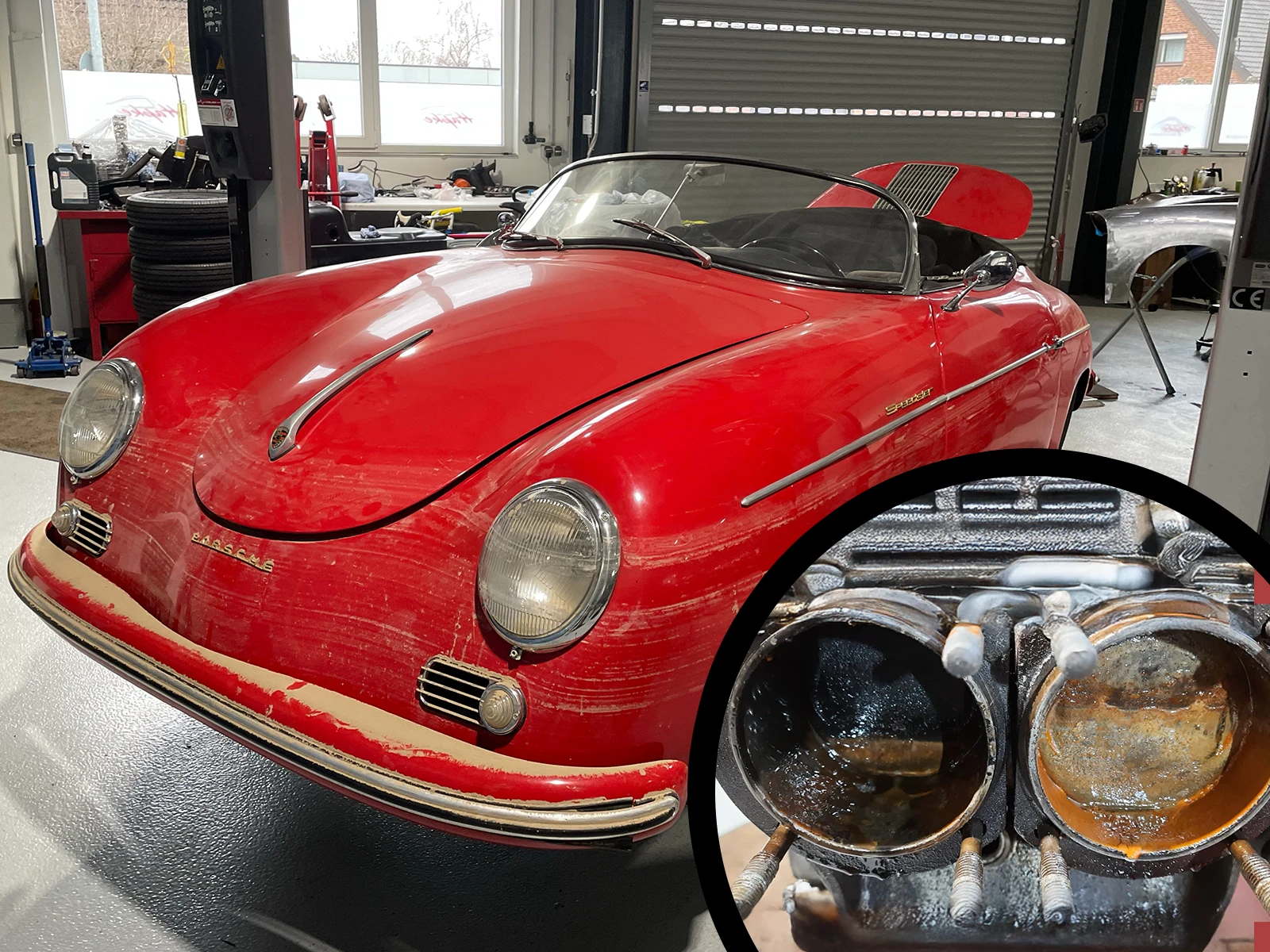
Condition upon arrival: Porsche 356 Speedster, water damage
The same applies to fire damage: in addition to the visibly affected structures, fires alter materials in ways that are not always immediately apparent. Heat can weaken load-bearing structures, destabilize components, and destroy surfaces. Even damage that initially appears to be superficial and repairable therefore requires careful, informed analysis and targeted reconstruction.
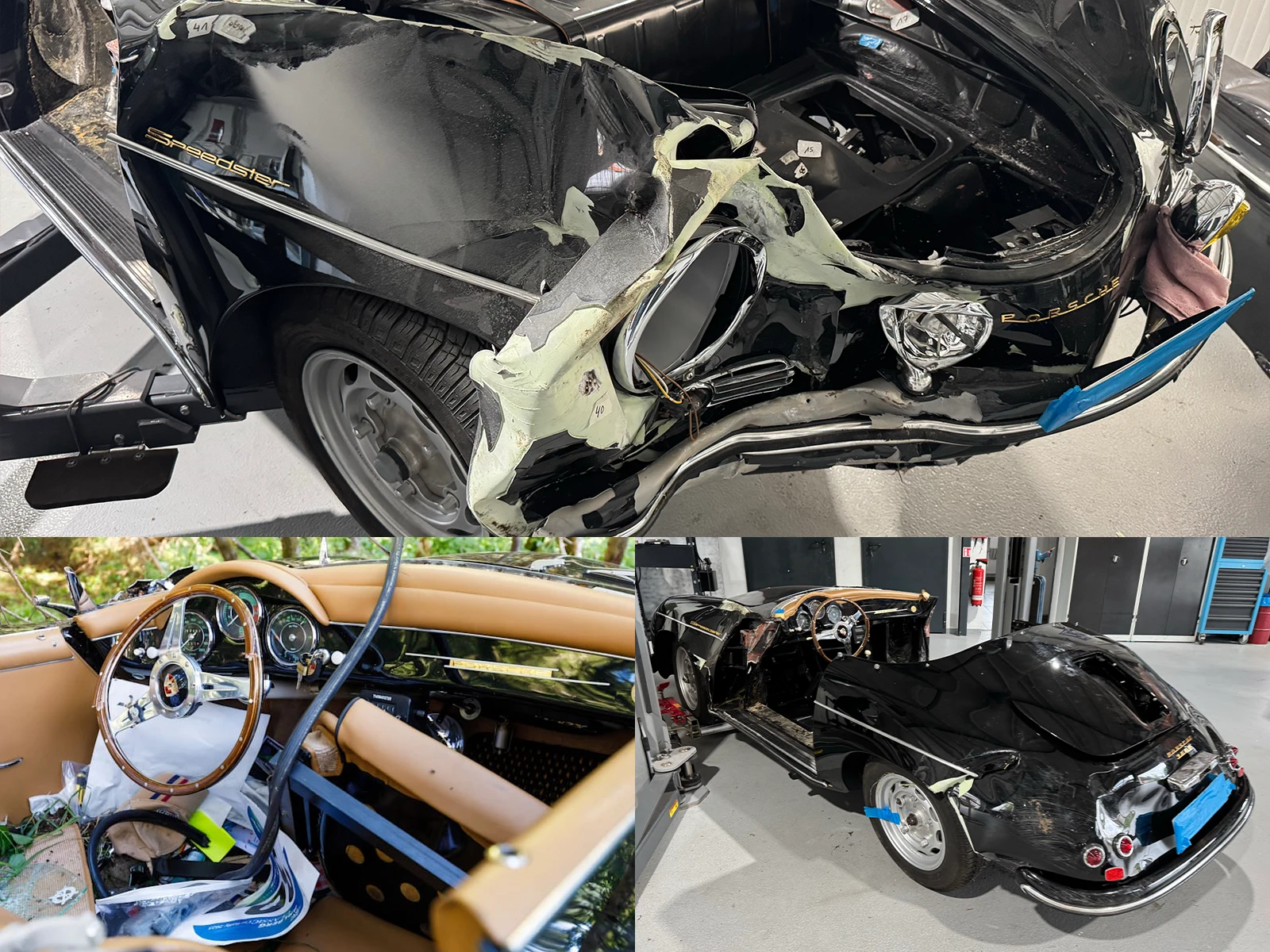
Porsche 356A Speedster, extensive accident damage
Between craftsmanship and history:
What makes the restoration of classic cars so special
Workshops for modern mass-produced vehicles operate under completely different conditions: high production volumes, industrially manufactured components, standardized materials, paints, and spare parts that are readily and easily available at any time. With rare historic vehicles, however, the situation is entirely different.
Our work revolves around handcrafted sheet metal and aluminum bodies, including add-on components, rare materials and paints, as well as manufacturing techniques that are scarcely mastered today. The required spare parts are not simply taken from a catalog—often, they no longer exist at all.
Historic vehicles therefore require understanding from us:
an understanding of construction and material behavior, of historical manufacturing methods, and of the logic and vision on which these vehicles were originally based.

Professional damage management means for us: we must understand a complex interplay of technology, history, as well as emotional and economic value, in order to preserve a historically outstanding vehicle for the future.
Marcel Hapke, founder & managing director
This requirement is complemented by a second layer that goes beyond the purely technical and material aspects: the often considerable financial and cultural-historical value of these vehicles necessitates close coordination with appraisers and insurance providers. The provision of authenticity documentation, the recording of remaining original components, as well as the derivation and justification of all necessary measures form an integral and substantial part of the entire restoration process.
Hands-on: How damage handling
and accident repair at Hapke Original Restoration works
Damage to a classic sports car is rarely straightforward—accordingly, restoration at Hapke Original Restoration does not follow a rigid scheme. Over the years, however, through close collaboration with appraisers, insurance providers, and of course the owners, we have developed a structured, flexible, and transparent process that guides our work.
Step 1: Thorough damage analysis
• Visual inspection and technical evaluation of damage
• Identification and assessment of hidden damage
• Classification of structural impacts using material analysis
Step 2: Documentation of original condition
• Detailed inspection and recording of the current condition
• Securing of areas worth preserving
• Coordination regarding the actual extent of the damage
• Creation of a reliable basis for later expert reports and documentation
Step 3: Coordination with appraisers and insurance providers
• Close collaboration with experienced and competent partners from our network
• Transparent presentation of the full extent of the damage
• Joint definition of the repair/restoration scope
Step 4: Consultation, coordination, and definition of the restoration scope
• Consultation with the owner regarding damage extent and intended restoration
• Weighing the best possible preservation of original material against reconstruction of destroyed components and (re-)establishment of safety requirements
• Joint definition of objectives with regard to achieving optimal technical, historical, and economic value preservation
Step 5: Reconstruction and restoration
• Commencement of work according to historical manufacturer specifications using appropriate fabrication and restoration techniques
• Where possible: repair and preservation of original substance instead of replacement
• When necessary: custom reproduction of missing or destroyed components
Step 6: Final technical inspection
• Thorough inspection of function, stability, safety, and appearance
• Ensuring roadworthiness and structural integrity
Step 7: Complete documentation
• Comprehensive, traceable digital documentation in text and images of all work steps carried out, ensuring optimal value preservation through the vehicle’s history
Whoever seeks to reconstruct history must understand it
With nearly 30 years of experience working with historically significant sports cars, one inevitably learns a great deal. Above all, however, one develops a deep understanding of the interplay between materials and construction, manufacturing techniques, and the individual history of each model. Over the years, we have not only refined and expanded the craftsmanship expertise of our restoration workshop, but also built a reliable and extensive network of appraisers and established cooperation with nearly all major insurance providers.
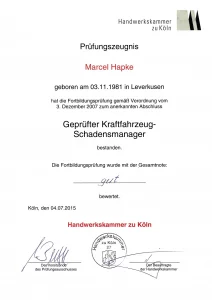
As a TÜV-certified damage manager, Marcel Hapke also holds a qualification that demonstrates his ability to combine structured methodology with hands-on experience—a combination that, in this form and within this industry, is exceptionally rare for historically significant vehicles.
The result: work that goes far beyond mere repair. Wherever possible and appropriate, we preserve original material to the greatest extent feasible. Where reconstruction is unavoidable, we carry it out based on historical manufacturer specifications and in-depth practical experience—always historically accurate, technically sound, and of course thoroughly documented and traceable.